



Somali civil society proposes interim electoral model to break political deadlock
 0
0
- Visits: 1004
-

- Share
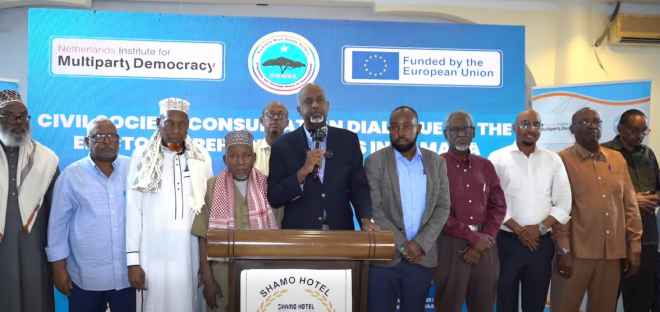

Somalia Non-State Actors (SONSA) has proposed an interim electoral framework that it says could help resolve the political deadlock over Somalia’s elections.
The civil society network said Somali civil society organizations have been working to identify a compromise between the federal government and opposition groups over the country’s disputed electoral process.
Following consultations with community leaders, SONSA proposed a Transitional Constituency-Based Multiparty Electoral Model.
Under the proposal, citizens would directly elect members of the House of the People from agreed electoral constituencies.
Candidates would contest the elections through registered political parties, but voters would cast ballots directly for individual parliamentary candidates rather than voting only for closed party lists prepared by political parties.
SONSA said temporary safeguards should be established during the transitional period to ensure inclusive representation and prevent communities or groups from feeling excluded from the political process.
The group said the electoral framework should include meaningful participation by federal member states in implementing the vote, including coordination on electoral security.
It also called for an independent and credible mechanism to resolve electoral complaints and disputes.
SONSA said voter registration, voting, vote counting and the announcement of results should be conducted through transparent and mutually agreed procedures.
The organization also called for safeguards to protect political rights and inclusive representation, particularly for women and communities historically vulnerable to political exclusion.
It said those safeguards should include protections linked to the 4.5 power-sharing system, as well as clear and enforceable measures to strengthen the political representation of persons with disabilities.
SONSA also urged international and domestic election observation, including monitoring by civil society organizations.
The group said no electoral system can be considered credible or legitimate without sufficient political consensus and public confidence.
It said the strength and legitimacy of an election depend not only on the technical model adopted but also on the level of political agreement and the confidence of the Somali people in the process.
SONSA emphasized the electoral framework should be based on a broadly owned political agreement involving the federal government, federal member states and opposition political stakeholders.
It noted Somali civil society should play a visible role in observing the process, facilitating dialogue and monitoring the implementation of any agreement.
The group encouraged political stakeholders to move beyond competing electoral proposals and show responsible compromise to establish an agreed transitional electoral framework that guarantees inclusive representation and federal consensus.
The proposal comes as a second round of Somalia’s electoral talks resumed in Mogadishu on Monday, with the federal government and opposition groups seeking consensus on elections and disputed constitutional amendments.
The talks, organized by Turkey, were attended by representatives of the federal government, the Somali Salvation Forum and Nabad iyo Nolol, as well as delegates from Turkey, the United States, the United Kingdom, the European Union and the United Nations.
Sources said the meetings were held separately, with each opposition group and federal government representatives meeting mediators on their own.
The first round of talks focused on each side submitting its preferred electoral model, while the second round is focused on discussing and comparing those models.
Four electoral models have been submitted to the mediators, according to sources familiar with the process.
No agreement has been reached, and the electoral model remains one of the main points of dispute.




 Facebook
 Twitter
 Youtube
 Google+
 RSS Feed
Somali civil society proposes interim electoral model to break political deadlock
.