



Lebanon's President and Trump Talk Hezbollah Disarmament in Key Discussion
 0
0
- Visits: 1092
-

- Share
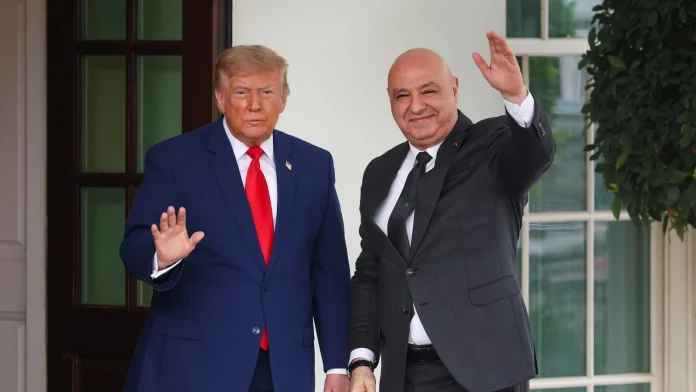

Mr Aoun, who served as the commander of Lebanon’s US-backed army before being elected president last year, became the first Lebanese head of state to visit the White House in nearly 20 years when he met Mr Trump.
The meeting stretched to nearly two hours and came against the backdrop of a continuing Israeli presence in a swath of southern Lebanon, while hundreds of thousands of Lebanese remain displaced after Israeli strikes.
At home, Mr Aoun faces deep resistance from Hezbollah, which has rejected the government’s direct talks with Israel as well as efforts by the state to disarm it.
"It’s been a very badly treated place and country, and we’re going to have it properly treated and treated with respect that it deserves,” Mr Trump said as he hosted Mr Aoun in the White House’s Oval Office.
Month-old agreement brokered by Washington
Mr Aoun’s White House visit followed a Washington meeting on Sunday with US Secretary of State Marco Rubio, where the Lebanese president said Israel should begin withdrawing from southern Lebanon under a US-brokered 26 June agreement between Lebanon and Israel.
The deal is designed to disarm Hezbollah, pave the way for a progressive Israeli troop withdrawal and lay groundwork for peaceful ties between the two countries.
How Lebanon could convince or compel Hezbollah to surrender its weapons remains an open question. The Shi’ite group was founded by Iran’s Revolutionary Guards in 1982 and for years stood as Lebanon’s dominant political and military force. Its sway has diminished since Israel’s 2024 offensive against it and the fall of its Syrian ally, former President Bashar al-Assad.
In a sign the plan was moving from paper to practice, Lebanese army troops began taking control of territory vacated by Israeli forces in southern Lebanon just hours before Mr Aoun’s meeting with Mr Trump the first test of the initiative.
A Lebanese official said Aoun believes only Mr Trump has enough leverage to press Israel to withdraw its troops and help Lebanon restore its sovereignty, noting Washington’s role as Israel’s closest ally and primary arms supplier.
The official said Mr Aoun, along with urging the US president to push Israel toward a pullback, would also hand Mr Trump a written proposal detailing how Lebanon could decommission Hezbollah’s vast arsenal.
"This will be your legacy,” Mr Aoun told Mr Trump in front of reporters as their meeting got under way. "Together, we will be able to achieve this objective. It’s about time for Lebanon and the whole region to be stable and secure.”
Mr Trump said he would be willing to speak with Hezbollah’s leaders if Mr Aoun thought doing so would be helpful.
He also raised the possibility that Syria could play a part in efforts to disarm Hezbollah. "Well, it’s a concept,” Mr Trump said, responding to a reporter’s question.
We need your consent to load this rte-player contentWe use rte-player to manage extra content that can set cookies on your device and collect data about your activity. Please review their details and accept them to load the content.Manage Preferences
Lebanon army says Israeli forces fired near soldiers in south
On the ground in southern Lebanon, the Lebanese military said Israeli troops fired near its soldiers as they deployed in a so-called "pilot zone” that Israel is to withdraw from under a US-backed agreement. Israel said it had only fired "warning shots”.
Israel invaded Lebanon during its recent war with Iran-backed militants Hezbollah, and it has continued to occupy parts of the country despite a ceasefire.
So far, Israeli troops have only controlled the outskirts of one of the so-called pilot zones, with their occupation of other areas yet to be addressed.
The Lebanese military already has a presence in the other two pilot zones.
"Military units began deploying this morning to Zawtar al-Garhbiya” in the Nabatieh region, the army said in a statement.
An AFP correspondent reported military vehicles one flying the Lebanese flag — entering the village, which lies at the edge of what Israel has dubbed the "security zone”.
The Lebanese army later said Israeli forces "opened fire in the vicinity of these units,” warning that the incident would hinder the deployment.
The Israeli military said it fired "warning shots into the air” after Lebanese soldiers entered an area that it said was "not part of the pilot area”, adding that no injuries were reported.
Maintaining that its troops had only deployed in Zawtar al-Gharbiya, the Lebanese army command said Israel "should address any problem through the Military Coordination Group for Lebanon (MCG4L) and through the approved coordination and communication channels, instead of carrying out attacks”.
Separately, the Lebanese Red Cross said two rescuers were wounded and an ambulance badly damaged when a landmine exploded near a convoy travelling to search for a missing person in an occupied area.
The Red Cross said it had obtained the required permits before entering and that it was working to secure safe passage for the wounded paramedics.
Lebanese soldiers unload equipment from trucks after deploying to the southern town of Srifa
‘Test’
The US State Department said on Monday that the Lebanese army had begun ensuring security in the villages of Zawtar al-Garhbiya, Froun and Srifa.
Israeli forces are not present in the latter two villages, which straddle the edge of the security zone, while they had deployed to the outskirts of Zawtar al-Garhbiya.
The Israeli military said it would "adjust its force posture in one of the pilot areas”.
The Lebanese army’s advance into Israeli-occupied lands an area reaching up to 10 kilometres into Lebanon — is being treated as a major test for the government, as experts question whether the state can disarm Hezbollah.
A resident searches through the rubble of his destroyed home in Srifa
Military expert Hassan Jouni said the deployment would be "a real test, first and foremost, of the Israeli army’s seriousness about withdrawing” and would also measure "Hezbollah’s position on the ground regarding this issue, as it rejects the principle of pilot zones and the agreement itself”.
"The biggest challenge will be continuing withdrawals from other pilot zones that are actually occupied” by Israel, he added.




 Facebook
 Twitter
 Youtube
 Google+
 RSS Feed
Lebanon's President and Trump Talk Hezbollah Disarmament in Key Discussion
.