



NUSOJ Warns Revised Penal Code Could Criminalise Journalism and Threaten Fundamental Human Rights
 0
0
- Visits: 1105
-

- Share
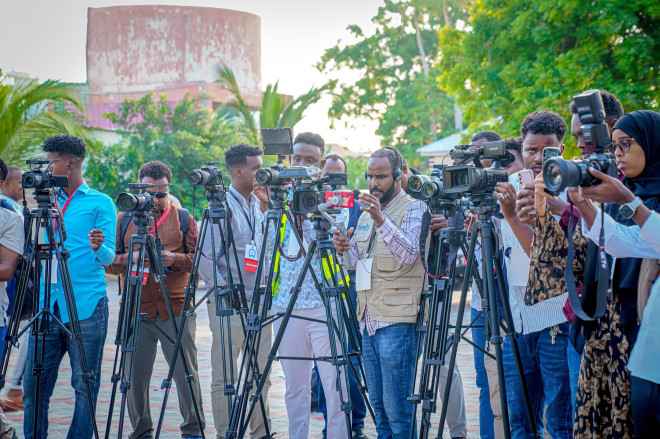

The National Union of Somali Journalists (NUSOJ) warned Friday that Somalia’s draft penal code could pose a serious threat to freedom of expression, independent journalism and other fundamental rights unless it is substantially revised before adoption.
The draft law was approved by the Council of Ministers on Dec. 4, 2025, and sent to the House of the People for consideration.
The union said its legal review found several articles that raise concerns under Somalia’s Provisional Constitution and the country’s international human rights obligations.
NUSOJ identified Articles 144, 157, 158, 163, 170, 221, 224, 235, 307, 308, 418, 420 and 423 as especially problematic. The union said the provisions include offenses related to criminal defamation of the president, false or misleading information, economic reporting, acts alleged to harm Somalia’s foreign interests, insult to the nation or state institutions, defamation of public officials and institutions, public morality, recording images without consent and electronic defamation.
The union said the articles could threaten investigative reporting, public interest journalism and citizens’ constitutional right to freedom of expression.
NUSOJ said the draft uses vague and broad terms such as "false information,” "national interests,” "public order,” "economic confidence,” "morality” and "insult” without clear definitions or sufficient safeguards against arbitrary enforcement.
The union warned that such wording could expose journalists and citizens to criminal investigation or prosecution for reporting on corruption, elections, security operations, governance failures and other matters of public interest.
NUSOJ expressed particular concern over the retention and expansion of criminal defamation and insult offenses, saying the draft grants special protection to public officials and state institutions from criticism.
The union said such provisions are inconsistent with African and international human rights standards, which require public officials to tolerate greater scrutiny and discourage the use of criminal law to protect reputation.
NUSOJ also said its review identified additional provisions that require amendment to better protect women, children, due process guarantees and other constitutional rights.
The union warned that if enacted in its current form, the law would represent a serious setback for constitutional rights and democratic governance in Somalia.
"It will expand the criminalisation of journalism, discourage investigative reporting, restrict public debate and weaken the role of the independent media in promoting transparency, accountability and good governance,” NUSOJ said.
NUSOJ Secretary General Omar Faruk Osman called the draft a defining test for Somalia’s legal reform process.
"This is a defining moment for Somalia’s legal reform process,” Osman said. "Reform must replace outdated, draconian laws with legislation that aligns with the Constitution and Somalia’s African and international human rights obligations, not extend restrictions that undermine fundamental rights and freedoms.”
He said the bill, in its current form, poses an immediate threat to media freedom and the public’s right to know.
"If enacted without substantial amendments, it will expose journalists, news media organisations and ordinary citizens to criminal prosecution for exercising rights that should be protected in a democratic society,” Osman said.
NUSOJ called on the Ministry of Justice and Constitutional Affairs and the House of the People to conduct a comprehensive, transparent and inclusive review of the draft before final consideration.
The union said it would continue engaging with the government and lawmakers during the legislative process by providing legal analysis and recommendations.
NUSOJ said Somalia needs a modern penal code that strengthens justice, protects human rights and safeguards independent journalism and free expression rather than criminalizing them.





 Facebook
 Twitter
 Youtube
 Google+
 RSS Feed
NUSOJ Warns Revised Penal Code Could Criminalise Journalism and Threaten Fundamental Human Rights
.